Pages

Showing posts with label #streetart. Show all posts

Friday, 22 May 2015

Paris today


Paris is full of pollen this Spring.

And rainbows.

The Luxembourg Gardens are always beautiful but this Spring the layers of green are more evident than last year.  Last year Spring exploded in one week.  The pollen didn't have time to build up.  This year, Spring is what we imagine and expect. 


I haven't posted in some time because I'm busy rewriting and planning a new website where I can encorporate my two blogs.  No idea when that will be because in October I have a show and have to produce 80 paintings.  Plus finish this rewrite.

Luxembourg Gardens is tourist Paris, though locals hang there too.  I do. It's in my hood.

But there is another Paris, a street artist's city. It's grungy and dark.  Here is a mural, in the 13th arrondissement, near the Biblioteque François Mitterand.  Notice the trees have no leaves.  This photo was not today.


The other side of Paris, the street art scene, is important in the manuscript I'm rewriting.  For the last year I have immersed myself in street art and graffiti.  It's exciting stuff, like the manholes on boulevard Saint Michel, where taggers descend into the catacombs -- backpacks full of goodies.

The working title is White Sky of Paris.  See the sky is?  In Paris the sky is often white.

An artist once told me he would mix phtalo green with quinadricone red and add white.  It was the perfect color for the Parisian sky.  I thought, yuck, you can't mix those two colors but he was right.


Thursday, 8 January 2015

Paris today.

Self-irony is not an art, any one is capable.  


We are all humans careening on the planet earth in a big black hole called the universe.  


We earthlings are exploding together towards some unknown meteorite called death.  


We are connected by our feet to a sphere of minerals,  stuck by a force called by gravity that no scientist or religion can define.  We walk on the same ball. 

All our heads in the same atmosphere, in the clouds. 

 There is only NOW.   

THIS is our paradise. 

Why do we have to take ourselves so seriously?  

We are all mortals, fornicating, birthing, educating and dying over and over.

Andoverandoverandoverandoverandover.


 Freedom of speech is our right as humans, anywhere, everywhere, anytime.

Tuesday, 9 December 2014

History of Graffiti: The origin of the word Graffiti

What is Graffiti?
 
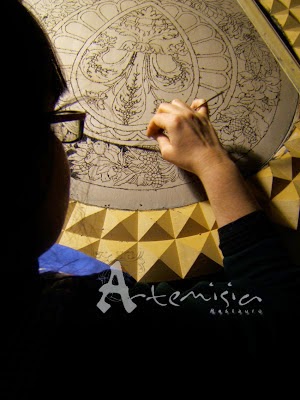
Artemesia restauro, Firenze, Italia


After hours of researching the origin of graffiti, I found that according to the Global Brittanica, the word graffiti derives from the Italian word sgraffito.

Because I speak Italian I know that the Global Brittanica gives a bad translation and because I am an artist I know their examples, in part, are lame.  Whoever wrote the definition says that in panel painting and illuminated manuscripts the ground was gold leaf.  That is not true.  For panel painting the ground was, and still is bolo.  I'm not sure about illuminated manuscripts but in both cases, sgraffito technique is not involved.  The Global Brittanica states that graffito technique was especially used during the middle ages but if you go to Florence or Venice you know that those buildings were decorated during the Renaissance.  That's a couple hundred years difference.

So what is Graffiti?

Here is a better definition:

According to the online Italian dictionary Treccani, graffito is a type of decoration used in architecture.  The graffer (my word from the commonly used French word graffeur) inscribes the wet stucco of a façade to reveal an under-layer.  The technique was (yes) used on medieval palaces but mostly done between 1400 and 1500.  In the 1700s there was a revival.  Following a design, the graffer removed the top layer of stucco and a exposed the colored underlayer.

Check out Artemesia Restauro's website. This image shows her doing a graffito.
Artemesia Restauro, Florence

Graffito.

Got it?


Treccani states:
Graffito is done through using a point to incise a surface - stone, metal, plaster, a wall, a vase, you name it.
  • It is a drawing or inscription on a surface or object, more often a wall.  In prehistoric times, documents were incised on rocks and clay tablets.  It seems banking records were incised on stone, thus the colloquial saying: written in stone. 
    Cuniform, courtesy of Iranicaonline
     Paleolithc caves,  catacombs, and  walls  are witness to graffiti.
In Mesopotamia over 5000 years ago scribes recorded information in stone. Saki Mafundikwa gives a wonderful TED talk about ancient African writing.
photo courtesy of mesopotamio.co.uk

In Pompei, Italy, phallus where commonly exposed outside a house to signify, Hic habitat felicitas  happiness lives here.
foto courtesy of Giovannidellorto
See, you did not invent this dick painting.  Some anonymous artist over 2000 years ago wrote it in stone.

Modern day graffiti seems to have all started in the toilet. Here is an excellent article on the Hiphop-Network:

Looking at the Writing on the Wall: A Critical Review and Taxonomy of Graffiti Texts © copyright 1995 Jane M. Gadsby

According to Gadsby's extensive bilbiography, over sixty years ago men and women  wrote on  bathroom walls.  Could this be the beginning of what we consider graffiti in modern times? She writes that "The 1970s were halcyon days of graffiti research".    

She writes that there are nine different approaches in graffiti writing. "As expected, each researcher chooses the approach which lends itself to fulfilling his/her needs. This has led to a wide array of approaches: cultural, gendered, linguistic, folkloric, quantitative, aesthetic, motivational, preventative and popularisation  

The Treccani dicitonary states that by analogy, graffiti as we know it today, started in NYC in the 1970's.  It states also that the film American Graffiti by G. Lucas in 1973, seems to have ignited the explosion.  Treccani's definition states that the film refers to the documentary value of prehistoric graffiti, a sign of the past.  And it was a revival of taste, fashion, clothing, music of the 1950's.


What is the definition of graffiti today?

Harvard University hosted a reception for the calligraffiti artist el Seed

Listen to what eL Seed says in this video: